Trust
Is Gadfly a cheating tool?
No. Gadfly works before an interview: it runs practice sessions, keeps your history and
refuses to hand you answers. It lives in a browser tab; the voice runs inside that same tab
and touches only your microphone and speaker — there is no overlay and it does not read your
screen. Using it during a real interview or assessment is against the
Terms, and the thing that gives AI cheating away, not being able to
speak to your own code in detail, is exactly what Gadfly trains. Some employers allow an assistant in the room; Gadfly trains for the room without one.
Will the tutor just agree with me, or invent a score?
In a tutoring session Gadfly never confirms that an answer is right; it asks you to check
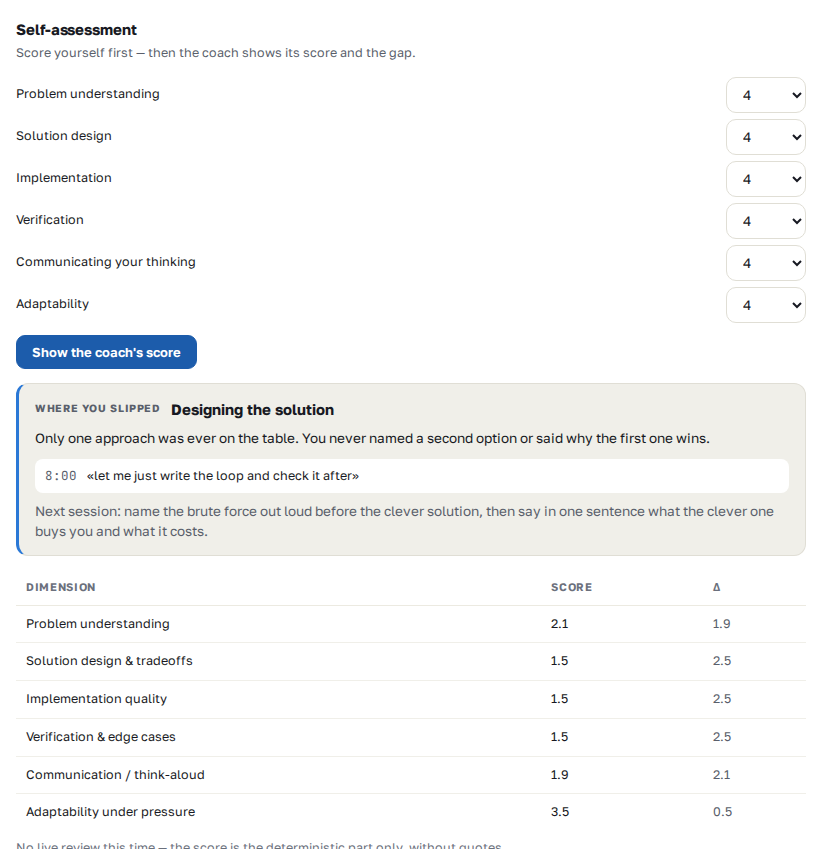
it against a case. In an algorithms mock you rate yourself first, then six axes are scored by
fixed rules over the record of the session; the model's reading is averaged in only where it
points at a moment that actually happened, and anything it cannot anchor is thrown out.
Scores are practice signals, not a verdict on you, and Gadfly never shows a readiness
percentage or predicts whether you will be hired.
Who runs Gadfly, and what happens to my history?
Gadfly is built and run by one person, Dmytro Hryshchenko — an individual, not a company —
and [email protected] reaches him directly. Your account and practice history live on a
server in Germany, and you can download all of it as one JSON file from Settings → Your data,
or delete the account there. When a pack ends, only starting new sessions stops: your
history and the export stay open.
Is it for me
AI mock interviews are free elsewhere. What am I paying for?
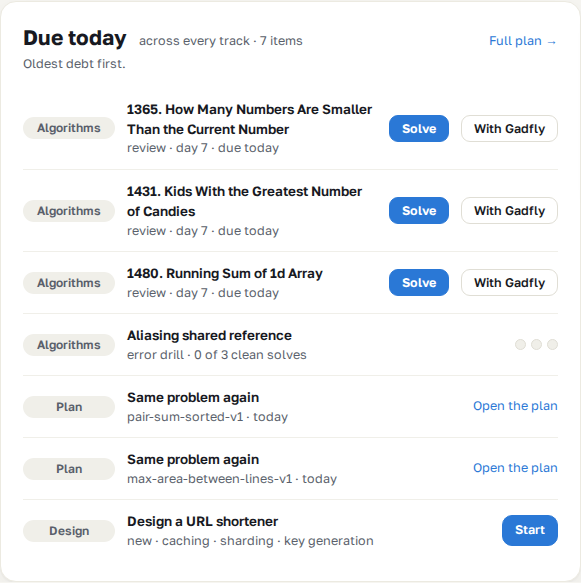
Sessions. The loop between them is not behind the wall: the diagnosis, the journal, the drills and the next problem are in the free sessions and in every pack, and so is mock mode. A pack buys more sessions inside a window. What a free mock elsewhere does not leave behind is a journal that counts the mistake you logged and picks the next problem from it. For one rehearsal before an onsite, a free mock is the right tool. For a loop of several rounds inside a month, the eight-session pack is sized for it.
Why not just use ChatGPT, Claude or Gemini?
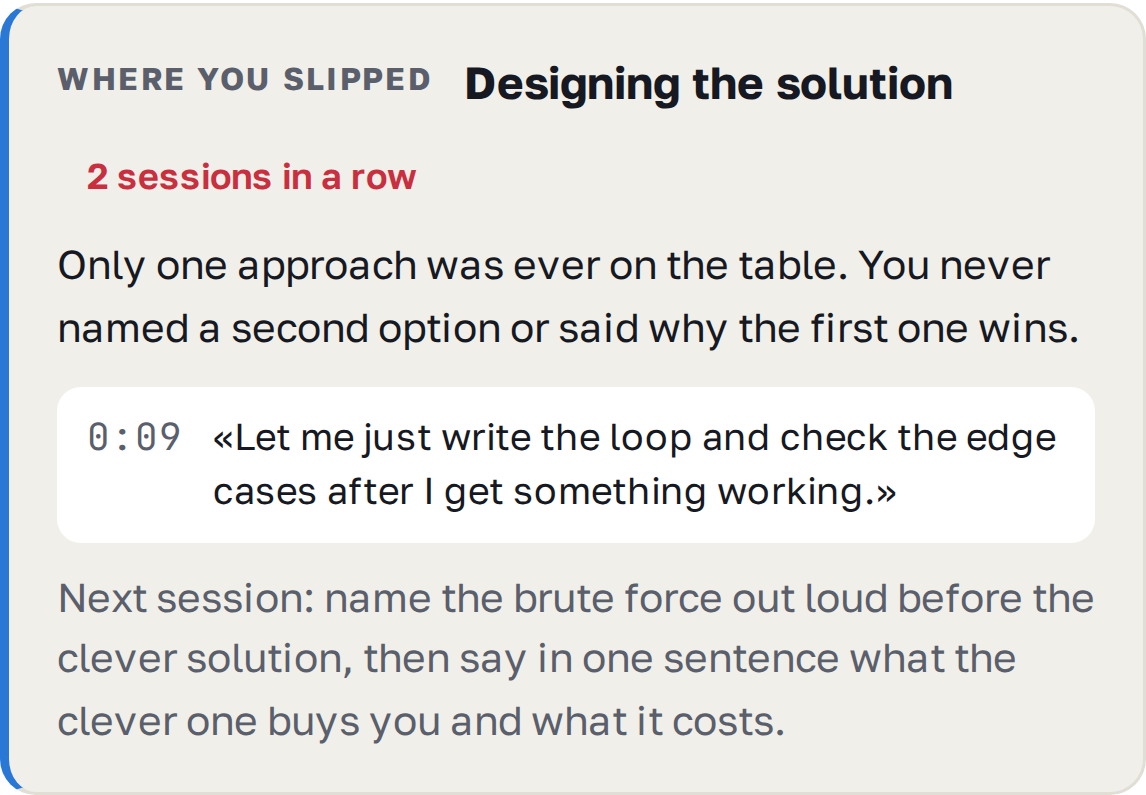
You can. For a concept you have never met, the full solution to a problem you gave up on, a warm-up before the interview or a voice mock with a small prompt, they are the right tool; they can be asked to hold back, they can remember you, and they are free or already paid for. Gadfly's tutor runs on the same kind of model; what is different sits outside it, and it files the part you would otherwise do by hand. An algorithms or system-design session closes with one slip, the minute and your words from the record, whether or not you ask, or with nothing when the record is too thin to show one. In an algorithms session you rate yourself before the coach's score appears, and that score is computed from the session record, not from your rating. The mistake you log goes under one class from a fixed list, is counted, closes after three sessions in which a problem that trains it ran green, and the next problem is scored against that journal. Use a chat when you need an answer tonight. Use Gadfly when you want the next tutor session to open with what this one found.
Does Gadfly replace LeetCode?
No. LeetCode and other question banks build pattern range, and Gadfly practises on that
catalog rather than replacing it. What Gadfly trains is the demonstration: clarifying the
problem, reasoning aloud, defending why a solution is correct, writing code under interview
conditions and adapting when the interviewer changes a constraint. Where a catalog problem has tests, they were written for it here and checked against an independent solution before they count.
Does Gadfly fit my level and my target company?
You set a goal as a company plus a level, and the practice plan follows it. Gadfly carries
company programs for Amazon, Apple, Google, Meta, Microsoft, Netflix and Uber; for any other
employer you still pick a level and work from the full catalog, without company-specific
weighting. Gadfly is independent and not affiliated with any employer.
English is my second language. Will Gadfly judge my accent?
No. Gadfly scores what you reason and decide, taken from the text of the session, not how
you sound. Speech recognition runs on your own machine and what it heard appears as text in
front of you, so a misheard word is one you can retype. If speaking gets in the way, the
whole session can be done by typing, with the same diagnosis and the same plan.
My interview is in two weeks. Is a pack of sessions the wrong product?
No — that is the case the smaller pack is for. Start with the two free sessions: they
include mock mode and each one ends with a diagnosis, so within days you know what to fix.
The shortest full cycle of the Gadfly loop is 14 days, because a problem comes back on day 1,
3, 7 and 14 — one pass at one weakness fits inside a fortnight. Eight sessions over 30 days
is roughly three evenings a week; if you have longer, sixteen sessions over 60 days is the
same product with more room.
Should I still do mock interviews with a real engineer?
If you can, yes, and Gadfly does not claim to replace one. A human notices things a model
does not. What a paid hour does not leave behind is the loop: Gadfly keeps the journal, names
the recurring weakness and schedules its return, so you walk into the next human mock knowing
what to watch for.
Using it
What do I need to run Gadfly?
A laptop or desktop on Linux, Windows or macOS, a current Chrome or Edge, and an
internet connection — the voice is local but the tutor's thinking is not. Nothing to
install: the voice runs inside the browser tab on about 1 GB of speech models that download
once into the browser's own storage, turn your speech into text and read the tutor aloud on
your own machine, and never upload audio. Chrome and Edge are what we test on; Firefox and
Safari are not verified. Without the download the tutor stays silent and the session works
in text.
Can I use Gadfly without a microphone, or on a phone or tablet?
Every Gadfly session can be done by typing: the tutor replies in text and the diagnosis
and plan are the same. Voice is the default because interviews are spoken. Phones and tablets
are not supported for sessions — the code editor needs a keyboard and a wide screen, and the
in-browser voice is not built for iPad, iPhone or Android tablets.
What counts as one session?
A session is one round on one track in any mode — tutor, solve or mock — and it is the
unit your free sessions and your pack are counted in. Gadfly counts it the moment it starts,
so a session you abandon still counts. There is no timer inside a session: you end it when
you are done. A tutoring session closes with a diagnosis and tomorrow's queue; a mock ends
with the interviewer's debrief.
What is the difference between tutor mode and mock mode?
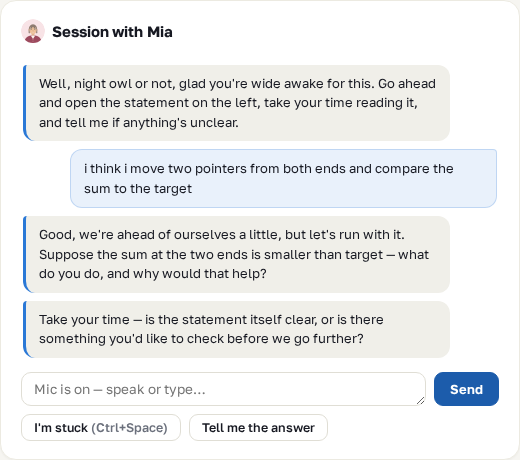
In tutor mode Gadfly asks the next question that moves your reasoning forward and never
reveals the solution; when you are stuck you press "I'm stuck" and get one more step, up to
pseudocode, but not the finished code. In mock mode it behaves like an interviewer: no
coaching during the round, and the debrief waits until the end. Neither mode has a countdown
— you end the session yourself.
Can I bring my own problems?
Not as pasted problem text — Gadfly has no field for that. The catalog is 711 LeetCode
problems tagged by pattern: pick one by number, title or pattern and the session opens the
real statement. Your own code is a different matter — the code review room, with a session
pack, takes a class of your own or a GitHub repository you connect.
What does the code review look at?
Gadfly reviews the code together with the transcript that produced it and the edits you
made while talking, not as an isolated snippet. It reads correctness, complexity, clarity,
edge cases and whether the code matches the reasoning you gave, and it names the follow-up
questions your choices invite. The goal is not prettier code; it is code you can defend.
Is there a limit on how much I can practise in a day?
Yes, and you can see it in Settings before you reach it. Each account has a daily usage
ceiling and the service has one of its own; when either is reached, live sessions pause for
the day and Gadfly says so instead of switching to canned lines. After about two hours or six
sessions Gadfly also suggests stopping, but that locks nothing. Your history, plan and export
stay available, and the ceiling resets the next day.
Paying and data
Is Gadfly a subscription, and what happens when a pack runs out?
No, it is not a subscription. Two sessions are free and need no card. A pack is one
payment for a set number of sessions and the days to use them — 8 sessions over 30 days for
£19.99, or 16 sessions over 60 days for £35.99, VAT included — with nothing renewing and no
card stored by us. A pack ends when its sessions run out or its days do, whichever comes
first; nothing is charged at that point and nothing is locked. Your history, plan and export
stay available, and if you buy another pack the sessions add up, each pack keeping its own
window. The Terms spell this out.
What if Gadfly does not work for me?
Try the two free sessions first — that is what they are for. After that, writing to
[email protected] within 14 days of paying gets you a full refund with no
reason needed, wherever you live; only above a handful of used sessions may it be reduced in
proportion. If the product never worked for you at all, that is a full refund regardless of
the 14 days, and days lost to an outage on our side are added back. Gadfly sells practice,
not a result: no preparation product can promise a hiring decision.
Where do my voice, my words and my code go?
Your audio never leaves your machine — recognition and the speaking voice run inside
your browser tab. The text of what you said or typed and the code you wrote go to Anthropic in
the United States to produce the tutor's replies, under standard data-transfer clauses, and
are never used to train models. Your account and practice history live on a server in
Germany. The privacy page lists every recipient, and you can export
everything or delete the account from Settings → Your data.
How do I sign in, and how do I delete my account?
With an email address and a password, or with Google or GitHub; you must be 16 or older,
and the free sessions ask for no card. Confirm the emailed link before your first sign-in.
Gadfly writes to you only about your account: confirmation, password reset, and 30 days'
notice before material changes to the Terms. To leave, open Settings → Your data, download
your data if you want it, and type DELETE — that removes the account, its sign-in and any
purchase record, and cannot be undone.